Changi Airport Infrastructure Aimed at Competitiveness

In this article (5)
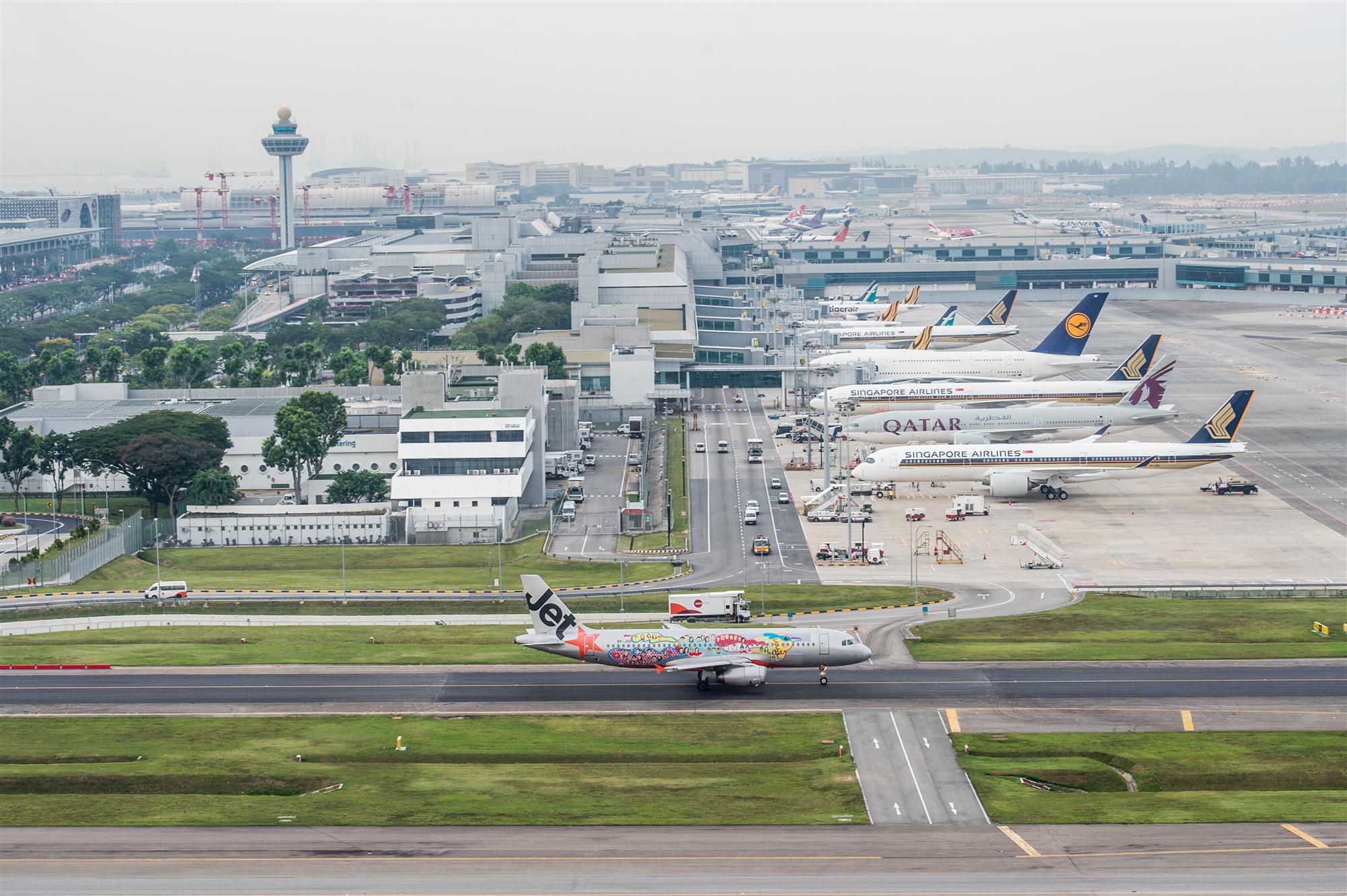
Singapore’s Changi Airport is already one of the leading aviation hubs in the world, but to help keep it competitive against the current backdrop of sluggishness, overcapacity and decreased yields, the airport has several large-scale infrastructural upgrades in the pipeline, in both the short and the long term.
“We look forward to two new facility openings – the DHL Express South Asia Hub and the SATS eCommerce Hub in the fourth quarter of 2016,” says Hui Hoon Phau, assistant vice president of the cargo and logistics development division at Changi Airport Group. “DHL’s 24-hour express facility will be able to support five times more flights in Singapore and three times more tonnage per day with their new hub. SATS will be the first ground handler in the world to own such an airside facility, with automated processes for single scanning and sorting to save cargo-processing time and increase efficiency.”
Announced in March 2015, DHL’s new €85 million (US$94.8 million) express facility occupies a total land area of approximately 26,000 square metres. It will also feature DHL’s first fully automated express-parcel sorting and processing system in Singapore and South Asia.
CAG also announced in March 2016 that it was launching a cargo community which would pursue the International Air Transport Association’s Center of Excellence for Independent Validators on Pharmaceutical Handling certification, similar to the approach adopted by Amsterdam and Brussels. Changi will be the first airport in Asia to implement such a community.
According to CAG, it will support six companies from different parts of the supply chain to undergo the certification process: Singapore Airlines Cargo, dnata Sinagpore, Global Airfreight International, Expeditors Singapore, CEVA Logistics Singapore and Schenker Singapore.
The Civil Aviation Authority of Singapore and the Singapore Development Workforce Agency will also jointly provide assistance grants to the company for the certification process, which includes training and independent assessments of requirements such as the capability of maintaining a cargo hold temperature range of 10-25°C, and the execution of appropriate temperature-controlled handling.
Phau says that the pioneer group of companies is on track to complete the IATA CEIV Pharma certification by next year.
Overall, air cargo traffic at Singapore has been relatively stagnant of late, at 1.83 million tonnes in 2012, 1.84 million tonnes in 2013 and 2014, and 1.85 million tonnes in 2015.
But that could change this year. “Although cargo traffic at Changi has remained stable over the past few years, this should be viewed against the backdrop of a slowing global economy which had in turn depressed air cargo demand,” says Phau. “That being said, air cargo volume at Changi had a healthy performance in the first six months.”
“That being said, air cargo volume at Changi had a healthy performance in the first six months.”
Boosted by strong performances in March, April and June, Changi handled 950,250 tonnes of air freight in the first half of 2016, a 4.2% increase compared to the same period in 2015.
“Double-digit growth was recorded by niche cargo segments such as perishables and pharmaceuticals, continuing the strong growth from previous years,” says Phau. “With Changi’s excellent facilities and connectivity in the region, there remains potential for carriers to tap into the global demand for such niche cargo by leveraging on Changi as a transhipment hub.”
Despite the sluggish growth of the global air freight market, the airport still managed to attract the arrival of two new freighter operators in June 2016, which saw the launch of K-Mile Air’s five-times weekly services between Bangkok and Singapore using a Boeing 737-400F, as well as Silk Way West Airlines’ commencement of twice-weekly 747-400F services between Singapore and Baku, with stopovers in Kuala Lumpur and Dubai.
There have been new passenger flights with bellyhold cargo too, such as United Airlines’ launch of a non-stop from San Francisco with a 787-9 in June and Singapore Airlines’ launch of Airbus A350-900 flights to Dusseldorf in July 2016.
“We remain confident in the long-term potential of the cargo business at Changi Airport,” says Phau. “To support the long term growth of Singapore’s cargo and logistics sectors, dedicated facilities for air freight and air express services, as well as MRO activities, will be developed as part of the Changi East development.”
According to CAG, the project involves the development of a 1,080-hectare plot of reclaimed land to the east of the current airport. It will include a fifth passenger terminal, a large air freight centre and a third runway, which is currently used by the military and is to be repurposed for civilian use. The entire project is estimated to be completed in the second half of the 2020s.
With all this investment, CAG feels that the airport is in a solid position to solidify its status as one of the major aviation hubs not just in the region, but across the world.
“Notwithstanding the healthy air cargo performance at Changi during the first six months, we remain cautiously optimistic in the short term, given the sluggish economic growth of world trade and the uncertainty of the Brexit impact on the air freight industry,” she says. “We continue to work with our partners to strengthen Changi’s capabilities, such as our pharmaceutical handling capabilities, and pursue growth in niche segments to ensure that we are well-positioned for future growth.”
Questions & Answers
Q.What new facilities are opening at Changi Airport in the fourth quarter of 2016?
What new facilities are opening at Changi Airport in the fourth quarter of 2016?
The DHL Express South Asia Hub and the SATS eCommerce Hub are set to open. DHL's facility will handle significantly more flights and tonnage, while SATS will be the first ground handler globally with such an automated airside facility.
Q.What is Changi Airport doing to improve its pharmaceutical handling capabilities?
What is Changi Airport doing to improve its pharmaceutical handling capabilities?
Changi Airport Group launched a cargo community in March 2016, pursuing IATA's CEIV Pharma certification. Six companies, including Singapore Airlines Cargo and dnata Singapore, are undergoing this process with assistance grants to enhance handling of temperature-sensitive cargo.
Q.How has Changi Airport's air cargo traffic performed recently, despite global economic sluggishness?
How has Changi Airport's air cargo traffic performed recently, despite global economic sluggishness?
Air cargo traffic was relatively stagnant from 2012-2015, but saw a healthy 4.2% increase in the first half of 2016 compared to the previous year. Niche segments like perishables and pharmaceuticals recorded double-digit growth.
Q.What long-term infrastructure developments are planned for Changi Airport?
What long-term infrastructure developments are planned for Changi Airport?
The Changi East development involves a 1,080-hectare reclaimed land plot. It will include a fifth passenger terminal, a large air freight centre, and a third runway. The entire project is expected to finish in the second half of the 2020s.
Reader pulse
Will Changi's cargo strategy effectively boost its competitiveness?
20,600 votes so far