Bigger Is Better for Singapore REITs Facing Consolidation

In this article (6)
Singapore’s real estate investment trust market is set to consolidate as smaller vehicles merge to cope with rising regulatory costs, according to Cambridge Industrial Trust.
“The wave of consolidation for Singapore REITs is about to begin,” Philip Levinson, chief executive officer at Singapore-listed Cambridge Industrial, said. The trust has a market capitalization of S$730.5 million ($536 million) and focuses on industrial real estate assets.
The city-state’s monetary regulator has tightened rules that could raise costs and lower revenues for REITs, making mergers between such trusts the most viable option for them to thrive, Levinson said. Morgan Stanley last year said consolidation in the Singapore REIT market was “unavoidable and necessary” to develop sufficient scale and stock liquidity for individual REITs to effectively compete on a global scale.
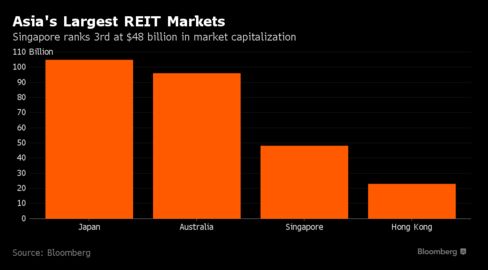
New rules put in place last year by the Monetary Authority of Singapore, requiring higher levels of disclosures, especially on fees, entail higher compliance costs and lower revenue potential for REIT managers. The new rules are especially punitive for smaller-scale REITs and the gradual widening of the gap with larger REITs would make conditions even more conducive to consolidation, Morgan Stanley said.
REITs that are not part of a broader index are significantly disadvantaged, Levinson said. Markets are bifurcating to such an extent where investors will only look at REITs that are included in indexes, he said.
Shabby Sheds
Cambridge Industrial will continue to focus on its Singapore assets and consider selling some to reinvest in other markets such as Australia and Japan, Levinson said.
“Japan is a very deep market with enormous spreads, but that’s the next step after Australia because it is expensive at the moment,”
“Japan is a very deep market with enormous spreads, but that’s the next step after Australia because it is expensive at the moment,” he said.
Industrial occupancy and rental rates in Singapore will remain under pressure in 2016 as new supply outpaces demand growth, according to Rachel Chua, a Moody’s analyst. Singapore REITs in the industrial space will continue their overseas acquisition spree in 2016 as they pursue asset growth, yield accretion and portfolio diversification amid challenging business conditions, Moody’s said in January.
Unit prices of Cambridge Industrial, with 51 properties located across Singapore valued at S$1.4 billion, dropped 17 percent last year and the shares were trading at a roughly 17 percent discount to the net asset value, or NAV, as of Dec. 31. The FTSE Straits Times Real Estate Investment Trust Index slid 11 percent last year, its biggest decline since 2011.
Levinson, who set up Blackstone Group LP’s Australia operations in 2009 before joining Cambridge Industrial, said he’s been meeting with investors who want to see the REIT work on lifting its unit price and the firm is exploring all options to help achieve that.
“Our real focus is to bridge the divide, reduce the gap between our current unit price and NAV,” Levinson said.
Questions & Answers
Q.What is driving the expected consolidation among Singapore REITs?
What is driving the expected consolidation among Singapore REITs?
The city-state's monetary regulator has tightened rules requiring higher disclosures, especially on fees. These new rules increase compliance costs and reduce revenue potential, making mergers a viable option for trusts to thrive.
Q.How will the new regulations affect smaller REITs compared to larger ones?
How will the new regulations affect smaller REITs compared to larger ones?
The new rules are particularly punitive for smaller-scale REITs, increasing their compliance costs and lowering revenue potential. This gradual widening of the gap with larger REITs is expected to make consolidation even more likely.
Q.What investment strategy is Cambridge Industrial Trust considering for its assets?
What investment strategy is Cambridge Industrial Trust considering for its assets?
Cambridge Industrial plans to continue focusing on its Singapore assets and may sell some to reinvest in other markets. It aims to buy 'shabby sheds,' or B-grade assets in A-grade locations, primarily in Australia, then potentially Japan.
Q.How did Cambridge Industrial Trust's unit price perform last year?
How did Cambridge Industrial Trust's unit price perform last year?
Unit prices for Cambridge Industrial dropped 17 percent last year. By December 31, its shares were trading at approximately a 17 percent discount to its net asset value.
Reader pulse
Will Singapore's REIT consolidation effectively boost global competitiveness?
19,681 votes so far